
In a tech marathon, capital efficient innovation beats sprinting out of the gate.
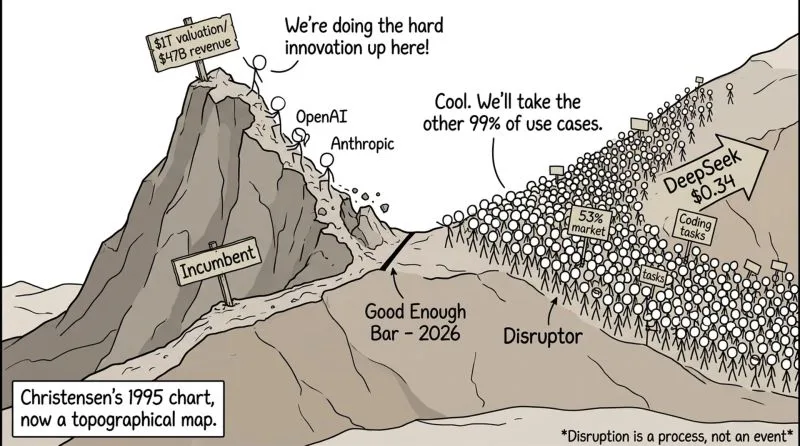
The papers coming out of China Frontier labs are as hard hitting frontier science as everyone else’s when it comes to “hard innovation”.
If anything, efficiency gains are a universal investment in all use cases - “hard” use cases require more compute, which becomes prohibitive at the techbro brute force “racing at low efficiency factor” we’ve seen over the last few years.
The crux with the “AI race” has always been that the goalposts are non-existent, mushy “Winner takes all AGI framing” and it was clear for a few years now that this was primarily fundraising narrative, not compatible with the fundamental limitations of the transformer.
Indeed, there is no race, only the endless marathon that’s technology innovation and adoption and, from that perspective, it’s entirely clear that blowing all your capital/gunpowder early in the race, at minimal efficiency, to make larger and larger explosions to draw more and more attention and the next round of capital, is not a winning strategy.
Necessity is the mother of invention, and innovation and, under the effect of sanctions, DeepSeek and others prioritised efficiency, pushing it up roughly by 3 orders of magnitude by now across their releases - a payoff that compounds with every future release.
It’s not that US labs aren’t innovating ... it’s just that they burnt a large part of the raised R&D capital to raise more capital, in the same classic failure mode that many charitable organisations fall to over time.
Those funds and valuations may look impressive, but they are hiding the downside: Investors need to be made whole and rich for their investments and soon and anyone building on top of these investments will pay 1
The resulting economics are deadly: DeepSeek’s highly efficient v3/r1 commoditised OpenAI’s o1 within half a year, an invention SamA’s company raised a $6.6 billion round off which valued it $157 billion post-money.
Again, not free money, money coming with ROI expectations. Both models are, a year later, in the rear view mirror, but its entirely clear that while DeepSeek showed they could be profitable on r1 inference and training costs (but chose user growth instead),
OpenAI never had a chance at ROI for the model, sunk cost on the way to the next round.
Chinese labs are doing the actual hard work too: Working business models.
The best example here is Sora vs. Seadream. It’s not even close - not just on model and capability, but more crucially, on actually working business model and scale.
The framing in the attached web comic massively understates the failure:
US labs have been maximally wasteful with available capital replaying the duopoly destination playbook for the 2010s, ignoring the fact that they’ve met their match:
An opponent that’s equally If not more competent, better provisioned and has deeper pockets, taking one of the valleys most popular playbooks: Fast Following open source and executing it perfectly.
They will now rely on government intervention to save their bacon, because they can't compete, long term, against companies that don't have to pay back their early investors on comparable scale.
The papers coming out of China Frontier labs are as hard hitting frontier science as everyone else's when it comes to "hard innovation". If anything, efficiency gains are a universal investment in… | Georg Zoeller
The papers coming out of China Frontier labs are as hard hitting frontier science as everyone else’s when it comes to “hard innovation”. If anything, efficiency gains are a universal investment in all use cases - “hard” use cases require more compute, which becomes prohibitive at the techbro brute force “racing at low efficiency factor” we’ve seen over the last few years. The crux with the “AI race” has always been that the goalposts are non-existent, mushy “Winner takes all AGI framing” and it was clear for a few years now that this was primarily fundraising narrative, not compatible with the fundamental limitations of the transformer. Indeed, there is no race, only the endless marathon that’s technology innovation and adoption and, from that perspective, it’s entirely clear that blowing all your capital/gunpowder early in the race, at minimal efficiency, to make larger and larger explosions to draw more and more attention and the next round of capital, is not a winning strategy. Necessity is the mother of invention, and innovation and, under the effect of sanctions, DeepSeek and others prioritised efficiency, pushing it up roughly by 3 orders of magnitude by now across their releases - a payoff that compounds with every future release. It’s not that US labs aren’t innovating ... it’s just that they burnt a large part of the raised R&D capital to raise more capital, in the same classic failure mode that many charitable organisations fall to over time. Those funds and valuations may look impressive, but they are hiding the downside: Investors need to be made whole and rich for their investments and soon and anyone building on top of these investments will pay [^1] The resulting economics are deadly: DeepSeek’s highly efficient v3/r1 commoditised OpenAI’s o1 within half a year, an invention SamA’s company raised a $6.6 billion round off which valued it $157 billion post-money. Again, not free money, money coming with ROI expectations. Both models are, a year later, in the rear view mirror, but its entirely clear that while DeepSeek showed they could be profitable on r1 inference and training costs (but chose user growth instead), OpenAI never had a chance at ROI for the model, sunk cost on the way to the next round. Chinese labs are doing the actual hard work too: Working business models. The best example here is Sora vs. Seadream. It’s not even close - not just on model and capability, but more crucially, on actually working business model and scale. The framing in the attached web comic massively understates the failure: US labs have been maximally wasteful with available capital replaying the duopoly destination playbook for the 2010s, ignoring the fact that they’ve met their match: An opponent that’s equally If not more competent, better provisioned and has deeper pockets, taking one of the valleys most popular playbooks: Fast Following open source and executing it perfectly. They will now rely on government intervention to save their bacon, because they can't compete, long term, against companies that don't have to pay back their early investors on comparable scale.
 linkedin.com